Yiwu Market: A Buyer's Guide to Yiwu International Trade City
For overseas importers, wholesalers and chain-store buyers, Yiwu Market — formally Yiwu International Trade City and known locally as Futian Market — is the starting point for sourcing small commodities in volume. It is not a single building but a campus of connected market districts, each with its own category zones, and it sits at the centre of a supply belt that includes Jinhua, Yongkang, Pujiang and Dongyang. This guide explains how the market is organised, how buying there actually works, and where solo buyers typically run into difficulty.
How the Districts Are Organised
Each district of Yiwu International Trade City concentrates related product categories, so a buyer's route through the market follows the categories on the requirement list rather than the building layout.
- District 3 carries signage for daily cosmetics and bags, among other categories — a practical first stop for buyers building a personal-care or bag range.
- District 4 is a home and daily-goods area, covering household items and general consumer goods in depth.
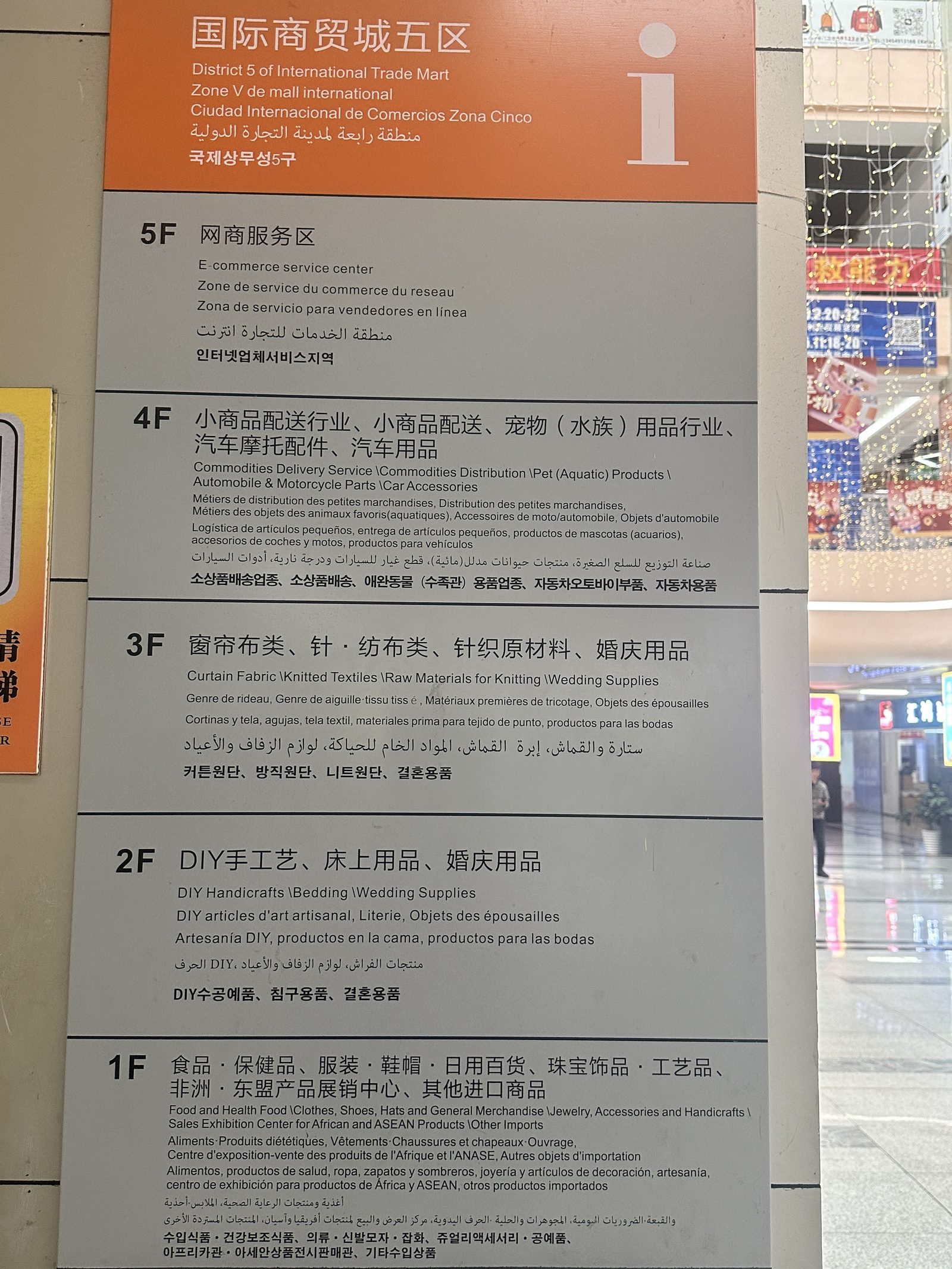
- District 5 covers bedding, curtains, auto accessories and imported goods, which makes it useful for buyers assembling a home-textiles or automotive-accessory programme.
Because categories are zoned rather than scattered, a buyer can compare many suppliers of the same item within a short walk. That density is the market's main advantage — and also the reason a buying trip needs a plan.
Why Buyers Come to Yiwu China
The draw is breadth. A single sourcing trip can cover household goods, hardware tools, bags, fashion accessories and jewellery, textiles and apparel, toys, small appliances, holiday gifts and spare parts — categories that would otherwise require several specialist suppliers in different regions. Per-style minimum order quantities are low by wholesale standards, typically in the 100–800 piece range depending on category, and mixed cartons combining several SKUs are normal rather than exceptional. For a buyer testing a new range or topping up a container, that combination of range and flexibility is hard to replicate elsewhere.
How Buying in the Market Actually Works
Buying at Futian Market is booth by booth. Most transactions follow a similar pattern:
- Walk the category zone and shortlist booths that carry the target item, noting the specification each one quotes.
- Request samples first. Comparing physical samples across booths is the only reliable way to judge material, finish and packaging.
- Compare prices across booths on the same specification, not on the headline figure alone — lead time and quality risk differ between suppliers quoting similar prices.
- Consolidate the goods. Purchases from multiple booths are collected at one warehouse, where they are checked, packed and prepared for export as a single consolidated load.
This booth-by-booth model rewards preparation. A buyer who arrives with a written specification, target quantities and a category sequence will move through the market far faster than one who browses.
The Problems Solo Buyers Hit
Three difficulties recur for buyers working the market alone. The first is language: negotiation, specification details and packaging instructions are easily lost in translation, and small misunderstandings become expensive at the inspection stage. The second is inconsistent quality between booths — two suppliers quoting the same item may differ meaningfully in material and workmanship, and without sampling and inspection the difference only appears after the goods arrive. The third is fragmented shipments: goods bought from many booths arrive at different times, in different carton formats, and a buyer without local coordination ends up with partial shipments and unclear documentation.
A local purchasing agent addresses these directly. At Mutual Trade, product selection compares three to five alternative suppliers on cost, lead time and quality risk; supplier screening includes background checks and on-site factory visits; and quality control runs across the order with IQC, IPQC, PQC, FQC and OQC checks, AQL 2.5/4.0 sampling and inspection reports with photos, video and defect lists. Goods are consolidated at a Yiwu warehouse — mixed cartons, relabelling, export cartons and pallets — and shipped by sea, air, China-Europe rail or express with the commercial invoice, packing list, certificate of origin and bill of lading prepared alongside.
Buying Remotely vs Visiting in Person
Visiting Yiwu in person remains the fastest way to judge suppliers and samples, particularly for a first order or a new category. Remote buying works when the specification is clear and the agent carries the physical checks: sampling and customisation (logo printing, colour matching, packaging, multilingual labels), factory visits, and pre-shipment inspection with the report sent at least three days before dispatch. Many buyers combine the two — a short visit to confirm suppliers, then remote repeat orders against agreed specifications. Seasonal and holiday ranges should be locked 90–120 days ahead either way.
The standard order cycle runs 30–90 days overall, from requirement confirmation through quotation and sampling, purchasing or production, inspection and consolidation to dispatch. For buyers weighing a first order, samples under US$2,000 can be settled by PayPal or Alipay, and larger orders by T/T or L/C. Enquiries can be sent to info@mutualdropship.com.
Related services & guides
Start with a compared quotation
Send us your product list, target prices and quantities — you get compared quotations, not a single take-it-or-leave-it price.
Get a Sourcing Quote