Yiwu vs Guangzhou Sourcing: A Practical Comparison for Wholesale Buyers
Most overseas importers who start looking at China eventually face the same question: yiwu vs guangzhou sourcing — which base should carry the bulk of the buying? The honest answer is that the two cities do different jobs, and the right choice depends on your order profile rather than on which market is "better". Yiwu International Trade City is built around breadth: a very wide range of small consumer commodity styles, low per-style minimums, and the ability to assemble a mixed-category shipment from a single market district. Guangzhou is built around depth: dense category clusters where a garment, bag, cosmetics or electronics range can be developed in one place with a deep supplier bench. Shenzhen sits alongside Guangzhou as the reference point for electronics and tech accessories. This article sets out the practical differences in assortment, MOQ, quality control, customisation and logistics, so you can match the base to the order rather than to the brochure.
What Each Base Is Known For
Yiwu: breadth of small consumer commodities
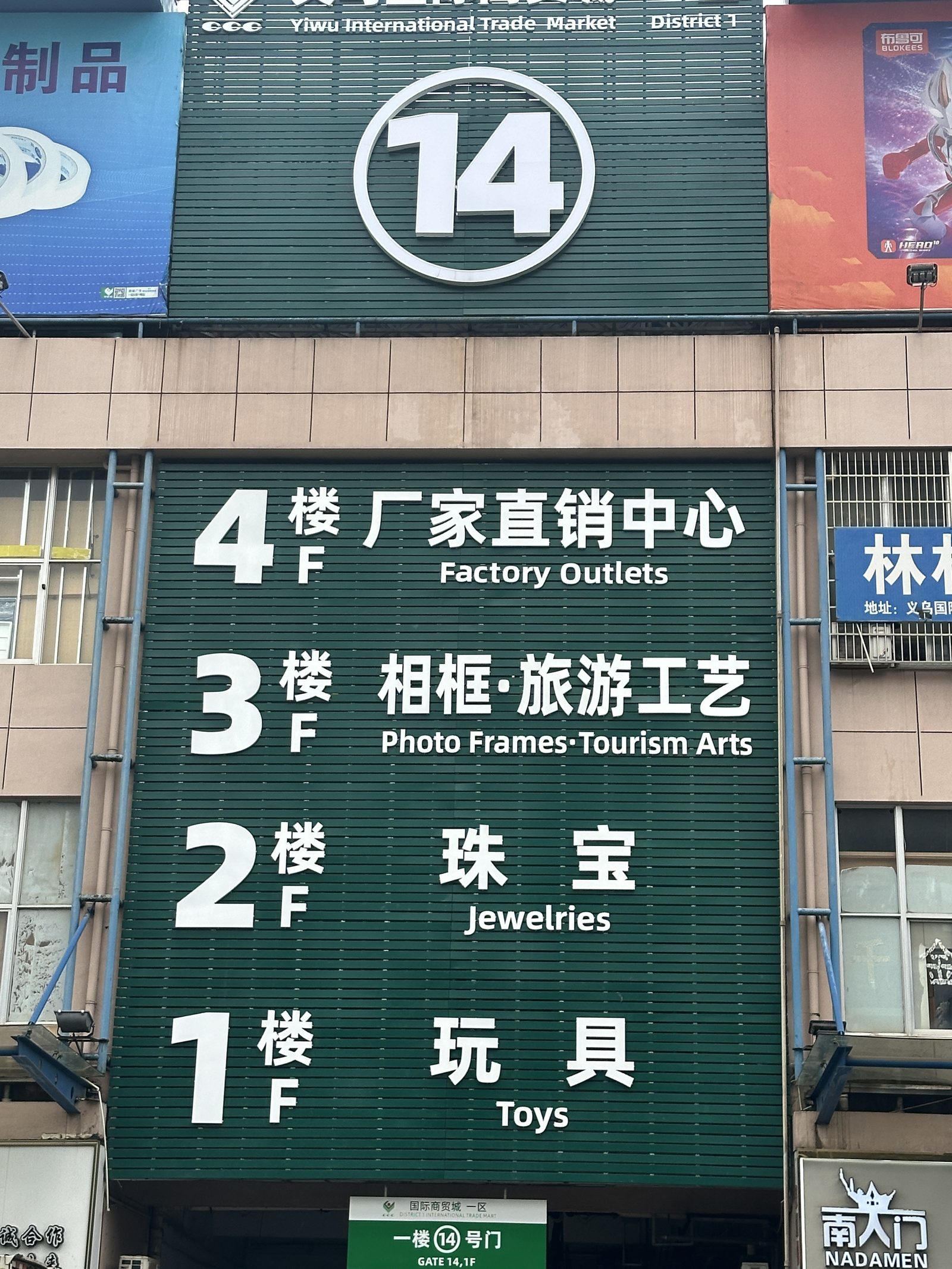
Yiwu's core strength is range. The Futian Market and the surrounding supplier network cover household goods, kitchen and cleaning items, stationery, party and seasonal products, fashion accessories and jewellery, toys, small gifts, basic hardware and tools, and much more — often several adjacent categories within a short walk. For a wholesale buyer assembling a container of assorted consumer goods, this density matters: you can compare many styles in one trip, and it is normal for a single order to pull from a dozen unrelated product families. The nearby industrial belts — Jinhua, Yongkang, Pujiang, Dongyang — add production depth in hardware, tools, textiles, and decorative and craft items, so the market is supported by real manufacturing rather than trading alone.
Guangzhou: deep category clusters
Guangzhou's advantage is concentration within a category. Its wholesale districts are organised around specific trades — garments and apparel, leather goods and bags, cosmetics and personal care, electronics and accessories — and each district carries a deep supplier bench, from small workshops to larger factories with in-house finishing. For buyers building a coherent range in one category, this depth shortens the search: you can see many suppliers of the same product type in a day, compare construction and finish directly, and negotiate a single-category run of meaningful size. Cosmetics and personal care also benefit from Guangzhou's concentration of packaging, labelling and filling suppliers, which simplifies a private-label programme.
Shenzhen: electronics and tech accessories
Shenzhen is the natural extension of a Guangzhou trip for anything with a circuit board: consumer electronics, chargers, cables, audio accessories, smart home devices and tech gift items. Component supply, tooling and assembly are closely clustered, which supports faster iteration on a design. Buyers sourcing electronics often keep Guangzhou for cases, packaging and accessories and Shenzhen for the electronic goods themselves, with both consolidated into one shipment.
MOQ and Consolidation Differences
This is where the two bases diverge most for a wholesale buyer.
Yiwu is built for mixing many SKUs
Yiwu's market structure suits low per-style minimums. Across the main consumer categories, typical MOQs run from roughly 100 to 800 pieces per style, with stock items at the lower end and customised items higher. That makes it practical to test a wide assortment — twenty styles at 200 pieces each — rather than committing deep to a few. Consolidation is equally native: a Yiwu warehouse can combine multiple SKUs and multiple categories into mixed cartons, bundle gift sets, apply seasonal packs, relabel for your market, and build export cartons and wooden pallets before dispatch. For a wholesaler or chain store that sells across categories, this "many styles, one shipment" model is the main reason to source in Yiwu.
Guangzhou is stronger for larger single-category runs
Guangzhou suppliers are generally oriented toward deeper production runs within one category. If your programme is a garment range, a bag collection or a cosmetics line at volumes well above the Yiwu per-style norm, Guangzhou's factory bench and cluster depth are a better fit, and per-unit costs improve as run length increases. Mixing is possible — a Guangzhou agent can consolidate several suppliers into one load — but the base is optimised for category depth rather than for assembling a hundred unrelated styles. Buyers who need both usually run the mixed consumer goods through Yiwu and the category programme through Guangzhou.
Quality Control and Customisation
Quality control works the same way in principle at both bases, but the practical emphasis differs.
- Yiwu: with many small suppliers and short runs, the risk sits in supplier variability — one style from one stall may be excellent and the next inconsistent. Screening, on-site visits and pre-shipment inspection carry proportionally more weight. Inspection across the order (IQC, IPQC, PQC, FQC, OQC), AQL 2.5/4.0 sampling with a stricter 0.65 level on request, photo and video reports, defect lists and re-inspection records are what hold a mixed order together. Batch samples and records kept for at least 12 months help when a style is reordered.
- Guangzhou: with deeper single-category runs, customisation is often more developed in-house — logo printing, colour matching, packaging and multilingual labels and instructions in 10+ languages are routine for garment, bag and cosmetics suppliers. First samples typically take 7-15 days. Compliance testing for EN71, ASTM F963/CPSIA, REACH, RoHS, FDA food-contact and CE requirements is coordinated with ISO 17025 third-party laboratories per product and destination market; the agent coordinates the testing but does not issue certificates itself.
In both cases, quality issues should be reported within 24 hours of detection and followed through a 24-48-7 day closure loop, so a defect found at inspection does not become a defect discovered by your customer.
Logistics: Ports, Rail and Transit
The two bases ship through different gateways, which affects routing and transit time.
- Yiwu dispatches mainly through Ningbo and Shanghai, two of the busiest container ports in the world, with strong coverage of Europe, the Americas and the Middle East. Yiwu is also a China-Europe rail hub, with rail transit of roughly 20-30 days — a useful middle option between sea and air for European buyers. Sea transit baselines from this corridor run about 30-45 days to Europe, 35-50 days to the US West Coast and 45-55 days to South America; air door-to-door is 7-15 days and express 3-7 days worldwide.
- Guangzhou ships through its own port system and, for many buyers, via Hong Kong, which offers dense air and sea schedules and flexible consolidation. Transit times are broadly comparable to the Yiwu corridor, with the routing determined by the destination and the carrier rather than by the city itself.
In both cases, terms can be quoted EXW, FOB Ningbo/Shanghai or Guangzhou, CIF or DDP, with the usual documents — commercial invoice, packing list, certificate of origin CO/Form A, bill of lading, insurance and customs declaration — plus HS code advice.
How to Decide by Order Profile
A few practical rules of thumb:
- Choose Yiwu when your order is a broad assortment of small consumer goods across categories, when you want to test many styles at 100-800 pieces each, and when mixed cartons from one shipment are more valuable than depth in any single line.
- Choose Guangzhou when your programme is concentrated in one category — apparel, bags, cosmetics, electronics wholesale — at larger run lengths, and when in-house customisation and packaging development matter.
- Add Shenzhen when the range includes electronics or tech accessories, keeping Guangzhou for cases and packaging.
- Lock seasonal ranges early. Holiday and seasonal goods should be confirmed 90-120 days ahead at either base, because sampling, production and sea transit do not compress well.
When Buyers Use Both Through One Agent
The comparison is not always either/or. Many wholesale buyers run a split programme: mixed consumer goods from Yiwu, a category range from Guangzhou, and electronics from Shenzhen, consolidated into one shipment and reported under one system. A guangzhou sourcing agent or shenzhen sourcing agent with a Yiwu presence can coordinate supplier screening, sampling, inspection and consolidation across all three bases, so you receive one set of inspection reports, one packing list and one bill of lading rather than three separate supply chains. For buyers new to China, that single point of coordination reduces the administrative load and keeps quality standards consistent across bases. For buyers already running one base, adding the second through the same agent is usually simpler than building a separate relationship from scratch.
The practical conclusion: Yiwu wins on breadth, low per-style MOQs and mixed-category consolidation; Guangzhou wins on category depth, larger runs and in-house customisation; Shenzhen covers electronics. Match the base to the order profile, and where the profile spans all three, run them under one consolidation and reporting system. To discuss a specific sourcing plan, contact info@mutualdropship.com.
Related services & guides
Start with a compared quotation
Send us your product list, target prices and quantities — you get compared quotations, not a single take-it-or-leave-it price.
Talk to a Yiwu Sourcing Agent